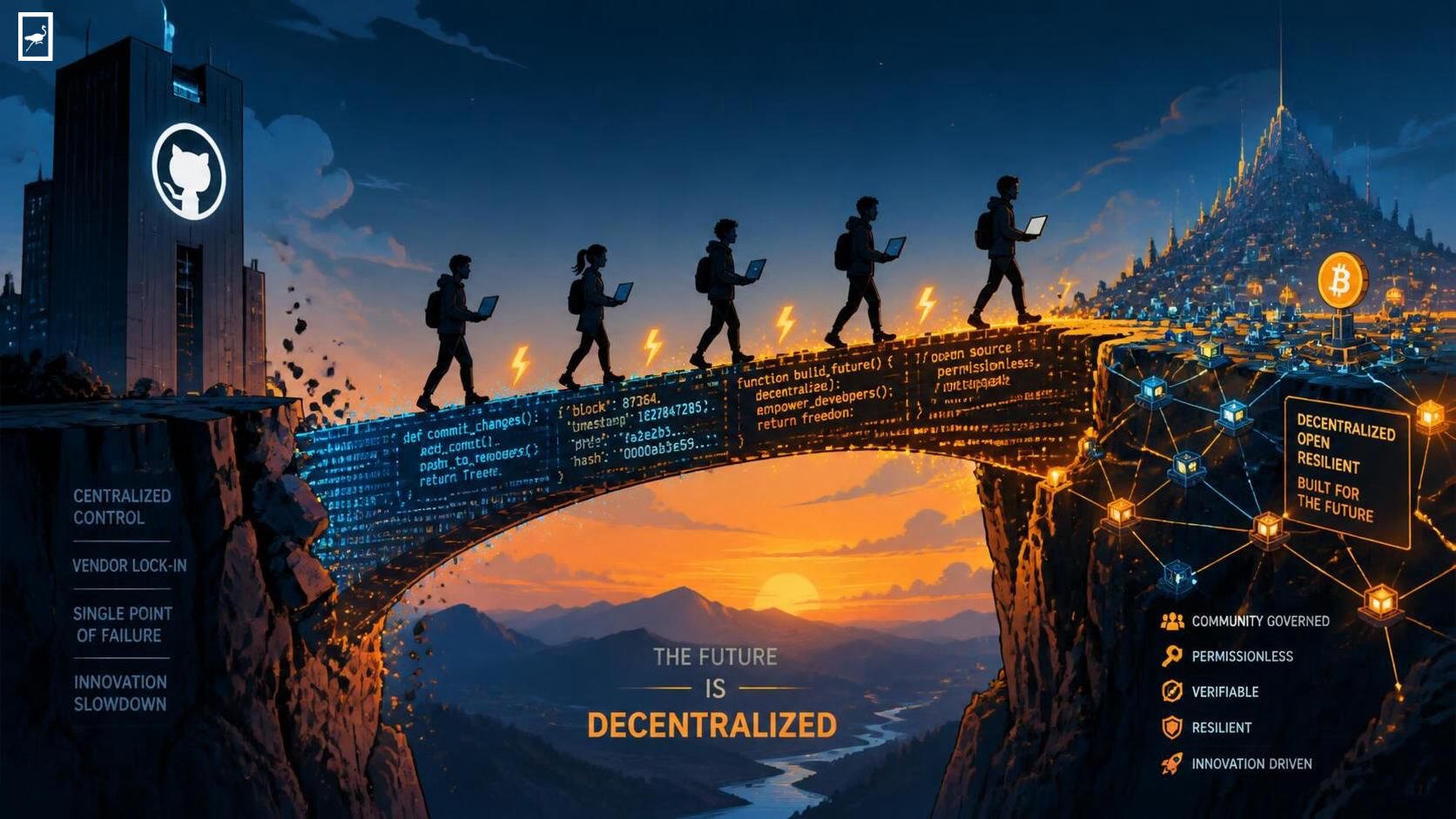
The decentralized Git ecosystem on Nostr quietly crossed a threshold this week. Gittr, the protocol’s answer to GitHub, released its stable version 1.0.0, according to Nostr Compass and The Frontier’s weekly technical feeds. It’s a milestone that sounds incremental until you look at what it actually enables: hosting repositories, opening bounties, importing from GitHub or Codeberg, and getting zapped for your work, all without a centralized platform standing between you and your code.
I think this matters more than the version number suggests. For years, the knock on Nostr was that it had great ideals and a thin toolchain. You could post notes and send sats, but if you wanted to do serious collaborative work, you eventually went back to GitHub, Slack, or Google Docs. That compromise is starting to disappear.
The Stack Is Coming Together
Gittr’s 1.0.0 release didn’t land in a vacuum. Git Workshop shipped version 4.1.0 with local recoverable drafts that survive browser restarts, which means you can close your laptop mid-edit and pick up where you left off without losing anything. NGIT CI version 0.1.1 introduced continuous integration with micro VM execution, letting self-hosted runners sell idle compute on an open marketplace.
The cause-and-effect here is straightforward. Developers don’t adopt a protocol because it’s philosophically superior; they adopt it because the tools work. When you can push code, run CI, manage pull requests, and get paid in Bitcoin without leaving the Nostr ecosystem, the switching cost drops dramatically.
And the payment rails are improving too. The Nostr Wallet Connect protocol merged updates for payment lookups this week, enabling transactions to be searched by hash or invoice while adding draft BOLT12 payment records. BOLT12 offers are reusable payment codes that increase receiver privacy and censorship resistance, which sounds technical until you realize it means a developer can publish a single payment offer and receive zaps for their work indefinitely without generating a new invoice every time.
The Funding Layer Is Maturing
Grants and funding have been flowing into this space for a while now. The Human Rights Foundation awarded grants to four Nostr projects including Vector and Flotilla Chat, focused on censorship-resistant encrypted communication. OpenSats has backed roughly 100 Nostr projects and developers through its dedicated Nostr Fund, according to comments from its podcast.
That funding is now producing visible artifacts. Gittr is one. Amethyst, the popular Android client, added BOLT12 payments and a fitness feature earlier this month. The Marmot group messaging specification clarified its key package flow, and a new moderation proposal introduced encrypted group reports that let administrators delete messages using signed events.
I’d argue the grant model is doing exactly what it’s supposed to. It’s funding infrastructure that wouldn’t survive on venture capital timelines, because the returns aren’t measured in quarterly growth but in protocol resilience.
What’s Still Missing
None of this means Nostr is ready for mainstream adoption tomorrow. The data sovereignty controversy that flared up this week, with accusations that relay operators will “spaff all of your publications absolutely everywhere without your permission,” shows there are still unresolved tensions between the protocol’s open nature and user expectations around consent and control.
There’s also the question of onboarding. Most developers aren’t looking for a new Git host. They’re looking for one that doesn’t break. Gittr 1.0.0 is stable, but stability on day one is different from stability in year one.
Still, the trajectory is clear. The pieces are assembling: identity that’s a keypair, payments that are zaps, storage that’s relays, and now code that lives on the same rails. Nostr isn’t just a social protocol anymore. It’s becoming a working environment.
Summary
Gittr’s stable 1.0.0 release marks a turning point for Nostr’s developer tooling. Combined with Git Workshop’s recoverable drafts, NGIT CI’s micro VM execution, and Nostr Wallet Connect’s BOLT12 payment records, the ecosystem now offers a functional alternative to centralized code hosting. Grants from HRF and OpenSats are funding the infrastructure, and the pieces are connecting into a coherent stack. The friction is still real, and the data sovereignty debate is unresolved, but the direction is unmistakable. Nostr is building the tools developers actually need, not just the ones that sound good in a manifesto.
Comments
Please login to comment
Login