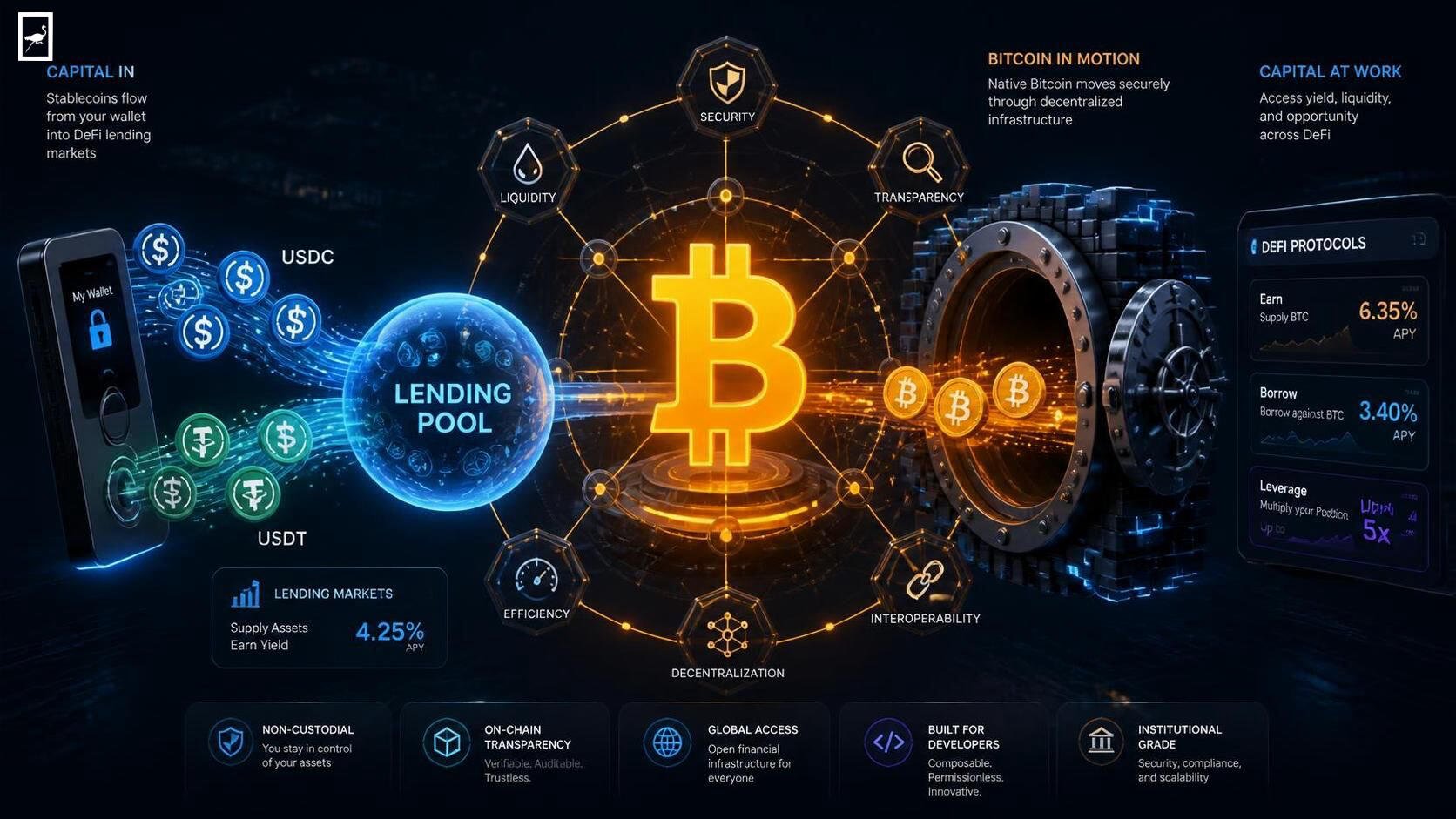
Ledger Just Made Self-Custody Lending Real
On Wednesday at TOKEN2049 in Singapore, Ledger unveiled Crypto Loan, a self-custodial lending feature that lets users collateralize wrapped Bitcoin to borrow stablecoins. The mechanics matter here. Eligible users can pledge cbBTC or wBTC directly within Ledger Wallet to borrow USDC or USDT. No transfers to centralized platforms. No selling your position. Every critical operation requires physical confirmation on the Ledger signing device before execution.
The feature runs on Morpho, the decentralized credit network, with Yield.xyz providing the technical rails. Morpho’s co-founder Paul Frambot described the integration as a “powerful liquidity flywheel,” where stablecoins deposited through Ledger’s existing Earn product can fund Bitcoin holders’ loans.
In my experience watching crypto infrastructure evolve, this is the kind of development that quietly reshapes behavior. Self-custody and yield generation have historically been mutually exclusive for most Bitcoin holders. Ledger just blurred that line.
Babylon and HashKey Bring Native Bitcoin to Institutional Lending
The same day, Babylon Labs and HashKey Cloud announced a partnership to integrate Trustless Bitcoin Vaults, or TBV, for native Bitcoin-backed borrowing and yield services. The key word is native. TBV lets Bitcoin holders use their actual BTC as collateral through Aave v4, without wrapping, bridging, or centralized intermediaries. This connects Bitcoin’s ecosystem directly to Ethereum’s lending liquidity.
Fisher Yu, Babylon’s co-founder, framed it around institutional demand in Asia. “Institutions want to put their Bitcoin to work through counterparties with regulatory status and an operating track record,” he said. “Our trustless, self-custodial design enables regulated institutions to use native Bitcoin as collateral and retain title.”
That last part deserves emphasis. Retaining title while borrowing against it is a structure traditional finance understands intimately. It’s the difference between Bitcoin as a speculative asset and Bitcoin as productive capital.
The Security Wake-Up Call Nobody Wanted
Not every story this week was about expansion. Core Lightning, the open-source software powering many Lightning Network nodes, issued an urgent warning on October 2. Attackers were actively probing unpatched nodes running version 26.06.7 or earlier. The team told operators to upgrade immediately.
Lightning nodes hold live balances in payment channels that sit off the main Bitcoin chain. A reachable, unpatched node can be messaged directly by its peers, turning a theoretical vulnerability into an exposed attack surface. Core Lightning has shipped multiple patches since August, including an embargoed release designed to give operators time to update before the underlying bugs became easier to reverse-engineer.
This is the uncomfortable truth about Bitcoin’s scaling layers. They work. They’re also software, and software has bugs. The Lightning Network’s growth depends on operators taking security seriously.
Miners Are Quietly Having Their Best Month Since January
Away from the headlines, Bitcoin miners collected $1.12 billion in September, up 11% from August and the highest monthly total since January’s $1.15 billion. Hashprice, the daily revenue one petahash of hashrate earns, climbed above $40 for the first time since May. Difficulty sits 15% below where it was a year ago, and the network hashrate is 18% lower than its October 2025 peak.
Translation: fewer competitors are splitting the same reward, and the machines that earn that reward are cheaper than they’ve been in two years. For anyone who wants to own hashrate, this is the most favorable set of numbers in recent memory.
Summary
This week in Bitcoin had little to do with price and everything to do with utility. Ledger launched self-custodial Bitcoin lending, letting users borrow stablecoins without surrendering custody. Babylon and HashKey brought native Bitcoin collateral to institutional lending through Aave v4. Core Lightning issued a critical security warning that every node operator should heed. And miners are quietly experiencing their best revenue month since January, with favorable economics for anyone looking to enter the space. The price may be flat, but the ecosystem is anything but.
Comments
Please login to comment
Login