The Problem
The problem with swapping across Bitcoin layers has never been liquidity. It’s discovery. How do you find a provider offering the exact asset pair you need, at a rate you can verify, without a central directory that can censor you or go offline?
KaleidoSwap thinks it has the answer. And it involves Nostr.
On the September 15 episode of the Stephan Livera Podcast, Walter Maffione, CEO and co-founder of KaleidoSwap, laid out how his project evolved from an RGB Lightning DEX into a broader swap engine and LSP stack. The conversation covered atomic swaps across Liquid, Arkade, Taproot Assets, Spark, and RGB. It touched on HTLC atomicity, BOLT 12 multi-asset offers, and a mainnet launch timeline of one to three months.
But the part that caught my attention was Nostr discovery.
Why Discovery Is the Real Bottleneck
In my experience covering decentralized infrastructure, the hardest part of any peer-to-peer system isn’t the cryptography. It’s the coordination. How do two parties find each other without a middleman?
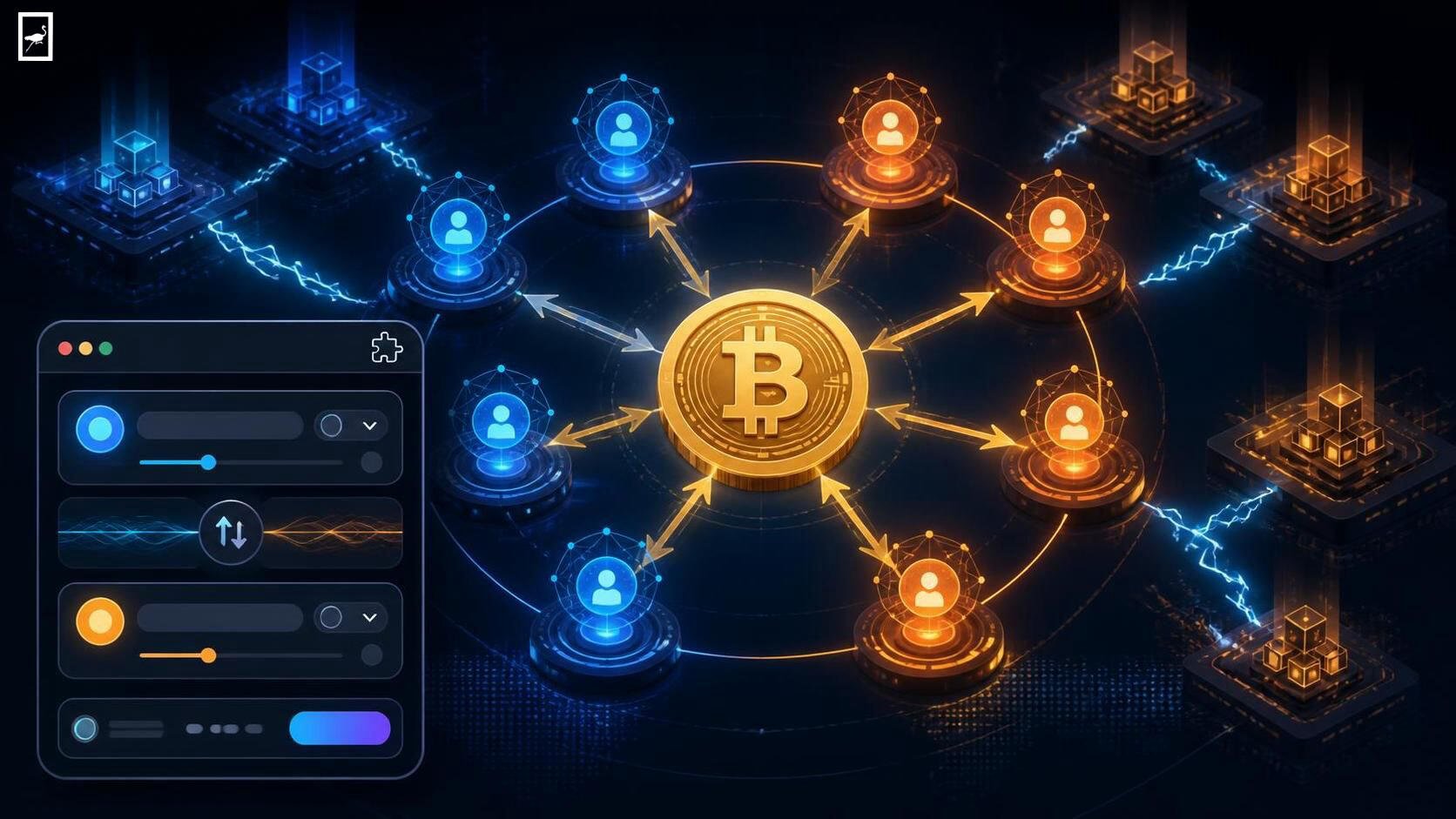
Nostr solves that elegantly. It’s a relay-based protocol where anyone can publish signed events. KaleidoSwap uses those relays to let competing swap providers announce their offers. Takers can monitor the network, discover active providers, and verify their economic commitments before initiating a swap.
This isn’t theoretical. The Coinswap protocol already uses Nostr for Maker discovery, with Makers broadcasting Fidelity Bonds over relays and Takers verifying the cryptographic proofs before swapping. FIPS, the mesh networking protocol, uses Nostr to resolve peer endpoints when nodes move or change ports.
KaleidoSwap is applying the same pattern to multi-layer Bitcoin swaps. Instead of a central order book, you get a permissionless discovery layer that no single entity controls.
The Technical Stack Is Coming Together
Maffione didn’t just talk about discovery in the abstract. He walked through the full stack. KaleidoSwap is building KaleidoSDK, a desktop app, a browser extension, and dual SDKs. The project supports Lightning as rails between multiple Bitcoin layers, with Flashnet and Utexo bridges for external stables.
The extension derives a Nostr identity from the same BIP39 recovery phrase used for Spark, Arkade, Liquid, and RGB-L1 accounts. That means one seed phrase controls your Bitcoin, your swap accounts, and your Nostr identity. The extension also includes a Nostr NIP-07 signer for browser-based event signing.
Fees are projected around 0.5 to 1 percent. The mainnet launch path for the extension, swap provider, and web app is one to three months out.
What This Means for the Broader Ecosystem
I think this is a bigger deal than it looks.
For years, the knock on decentralized exchanges has been UX. Finding a counterparty was clunky. Verifying their reputation was harder. Nostr changes that by providing a decentralized, censorship-resistant discovery layer that’s already battle-tested in other Bitcoin-adjacent projects.
It’s not just KaleidoSwap. The Coinswap protocol is using Nostr to let Makers broadcast Fidelity Bonds and Takers verify them cryptographically. This prevents Sybil attacks because the bonds represent real economic commitment. The FIPS mesh network uses Nostr to resolve peer endpoints, keeping connections alive even when IP addresses change.
Nostr is quietly becoming the coordination layer for Bitcoin’s multi-layer future. It’s not just a social protocol anymore. It’s infrastructure.
The Competition Is Watching
Maffione also touched on the competitive landscape. Boltz, another non-custodial Bitcoin exchange, runs on Nostr relays. There’s a healthy ecosystem of swap providers emerging, and Nostr discovery is becoming the common denominator.
The key differentiator will be which projects can ship the smoothest UX. KaleidoSwap’s approach of unifying Bitcoin, swap accounts, and Nostr identity under one recovery phrase is smart. It reduces friction for users who are already comfortable with self-custody wallets.
The one-to-three-month mainnet timeline is ambitious but not unrealistic. The team has been building since at least mid-2026, and the extension is already in testing. If they ship on time, they’ll have a first-mover advantage in the multi-layer swap discovery race.
The Bottom Line
Nostr’s role in Bitcoin is evolving. It started as a social protocol. Now it’s becoming the discovery and coordination layer for decentralized finance on Bitcoin.
KaleidoSwap’s use of Nostr for swap provider discovery is a concrete example of how the protocol’s decentralized relay architecture can solve real coordination problems. It’s not hype. It’s shipping.
Watch this space. The next six months will tell us whether Nostr becomes the default discovery layer for Bitcoin swaps, or just another experiment.
I know which side I’d bet on.
Comments
Please login to comment
Login